




A Director, a Promoter, and an Unexpected Baby
Jordan Firstman has built a reputation as one of the sharper comic voices orbiting New York’s queer creative scene, and his directorial début, Club Kid, channels that sensibility into something more structurally daring than a standard coming-of-age story. The film follows a gay promoter – the kind of person whose entire identity is organized around the architecture of nightlife – who discovers, without warning, that he is a father. It is the sort of premise that sounds like a setup to a punchline, and Firstman leans into that tension without ever fully resolving it.
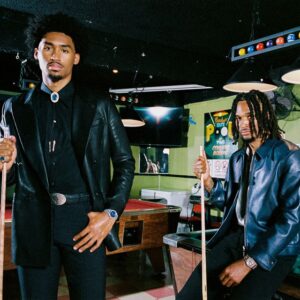
What anchors the film is the posse surrounding the promoter – a night-life inner circle rendered by three actors whose chemistry functions less like performance and more like a shared nervous system.
On a groggy Lower East Side morning, those three actors sat together and compared notes on queer family planning – a conversation that, by all accounts, blurred the line between research and autobiography in ways that shaped what ended up on screen.

Night-Life as Kinship Structure
The Lower East Side has served as a backdrop for New York’s queer underground long enough that it has become almost mythological – a geography of late exits and early light, of relationships forged somewhere between the second and fourth drink. Club Kid plants itself firmly in that tradition, but Firstman is less interested in the aesthetics of the scene than in what the scene actually does for people who have been structurally excluded from conventional family arrangements. The promoter at the center of the story hasn’t built a chosen family in the abstract sense that phrase gets used. He has built a logistical network – people who know where to be and when, who cover for each other, who share the particular exhaustion of keeping a world running that most people only visit.
That dynamic becomes the film’s real subject once the fatherhood revelation lands. The promoter’s posse isn’t decorative. They are the infrastructure through which he processes everything – grief, excitement, identity panic, whatever the discovery of a child produces in a man whose social architecture has been calibrated entirely around a different kind of life. Firstman reportedly worked closely with the three actors to let their own experiences with queer family planning – its legal complications, its emotional ambiguities, the specific bureaucratic friction that comes with non-traditional paths to parenthood – inform how those conversations feel on screen.
The result, by the actors’ own account during that Lower East Side morning, is a film that doesn’t treat queer family planning as a political statement or a corrective to mainstream cinema’s blind spots. It treats it as what it actually is for the people navigating it: logistically complicated, emotionally uneven, and frequently funny in ways that have nothing to do with mockery.

What the Cast Brought to the Morning After
The image of three actors comparing notes on queer family planning over what was presumably coffee – on the Lower East Side, presumably not before 10 a.m. – says something about how Club Kid was assembled. Firstman’s background is in short-form comedy and social media performance, where the distance between the creator’s actual life and the content being produced tends to collapse entirely. His directorial début carries that sensibility forward: the actors playing the promoter’s posse are not performing at the material from the outside.
Firstman’s choice to make his first feature about a gay promoter rather than, say, a more legible protagonist – an artist, a writer, someone whose interiority the audience is trained to take seriously – is itself a statement about where he thinks the interesting friction lives. Promoters are facilitators by definition. They make the night happen for other people. The comedy and the drama of Club Kid both hinge on what it looks like when that person suddenly has to make something happen for themselves, and for a child they didn’t plan for, and for a posse that didn’t sign up for any of this either.
The Lower East Side setting for that morning conversation among the cast is not incidental. The neighborhood is where New York’s queer night-life has historically done its actual living – not in the clubs themselves, but in the hours after, in the diners and stoops and corner conversations where the night gets processed into something resembling meaning. That is the territory Club Kid seems most interested in mapping.

The Debut as Declaration
Directorial débuts carry a particular weight because they tend to reveal what a filmmaker actually thinks is worth spending years of their life on, stripped of the compromise and negotiation that comes with more established careers. Jordan Firstman chose a story about a gay man learning he’s a father, surrounded by a queer chosen family whose members have done their own reckoning with what parenthood means outside the default settings – and he set it in the world of night-life promotion, which is perhaps the most rigorously anti-domestic professional environment New York produces. Whether the film manages to hold all of that without collapsing into sentiment or deflecting into pure comedy is the question the finished work will have to answer. What the cast’s Lower East Side morning suggests is that the rawness in the material wasn’t imported – it was already there, in the room, waiting to be used.