





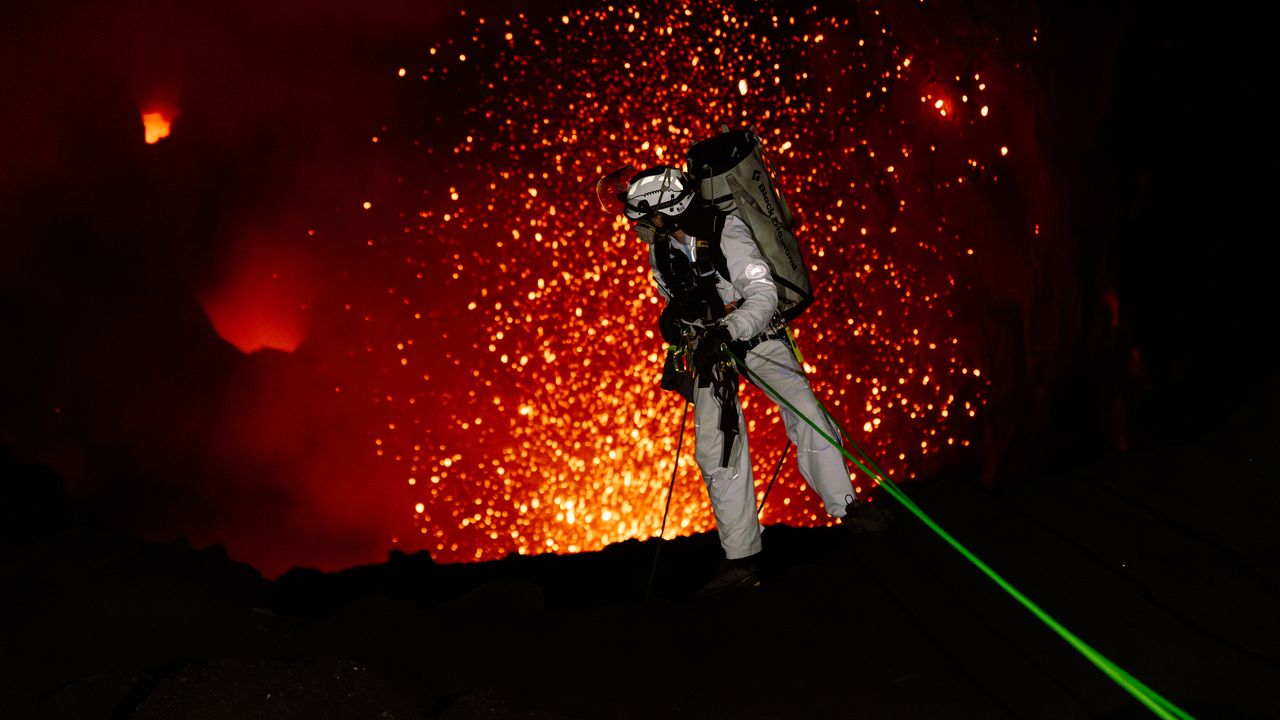
When Haider Ackermann needed to showcase Canada Goose’s Spring Summer 2026 collection, he chose one of Earth’s most dangerous backdrops. The designer dispatched volcano specialist Chris Horsley into an active crater, where molten rock and toxic gases create conditions that would send most photographers running.
Horsley found himself documenting the Snow Goose line while dodging projectiles that could kill him instantly. “It’s throwing lava bombs 300 meters into the air,” he explains. “There’s no escape.”
When Fashion Meets Extreme Photography
The collaboration between Ackermann and Horsley represents a calculated risk that few brands would attempt. Volcano photography requires specialized equipment that can withstand temperatures exceeding 1,000 degrees Celsius, while fashion campaigns demand pristine image quality that captures fabric details and color accuracy.
Horsley’s background made him uniquely qualified for this assignment. His previous work includes documenting active volcanic systems across the globe, from Iceland’s Eyjafjallajökull to Guatemala’s Fuego. The photographer understands both the technical demands of extreme environment shooting and the safety protocols that keep him alive in conditions where a single misstep proves fatal.
The Technical Challenge of Volcanic Fashion Photography
Inside the crater, Horsley faced obstacles that studio photographers never encounter. Volcanic gases corrode camera equipment within minutes, while ash particles can destroy lenses and sensors. The extreme heat warps standard photography gear, making precise focus nearly impossible.
Temperature fluctuations created additional complications for the Canada Goose garments themselves. The Spring Summer 2026 collection features lightweight technical fabrics designed for variable weather conditions, but volcanic environments push materials beyond their intended limits. Ackermann’s designs had to maintain their visual appeal while subjected to conditions that would destroy most clothing.
The photographer adapted by using specialized thermal-resistant housings and modified cooling systems for his cameras. Each shot required careful timing to avoid the worst sulfur dioxide emissions, which can cause immediate respiratory distress and equipment failure.
Lava bombs presented the most immediate threat during the shoot. These molten rock projectiles launch without warning and travel at speeds that make evasion difficult. Horsley describes working in 30-second intervals between eruptions, capturing images while constantly monitoring escape routes that might not exist.

The Snow Goose Collection’s Extreme Debut
Ackermann’s decision to launch the Snow Goose line in volcanic conditions reflects the collection’s technical ambitions. The designer aimed to demonstrate how high-performance outerwear functions in environments where failure means death, not just discomfort.
The resulting images capture models wearing Canada Goose’s latest innovations against backdrops of flowing lava and sulfurous steam. Each photograph required split-second timing to balance dramatic volcanic activity with clear product visibility.
Beyond Traditional Fashion Photography
This collaboration signals a shift toward experiential marketing that prioritizes authentic extreme conditions over controlled studio environments. While most fashion campaigns rely on carefully orchestrated lighting and predictable settings, Horsley’s volcanic shoot embraces chaos as a creative element.
The photographer’s approach challenges industry conventions about safety and artistic vision. Traditional fashion photography prioritizes model comfort and equipment protection, but extreme environment shoots demand different priorities entirely.
The images themselves serve dual purposes: showcasing Canada Goose’s technical capabilities while documenting one of nature’s most violent phenomena. Each frame captures both fashion details and geological processes that few humans witness firsthand. Will other luxury brands follow Ackermann’s lead into increasingly dangerous territories, or does volcano photography represent the absolute limit of where fashion marketing can safely venture?