




Seoul Has a Different Standard
South Korea has spent decades treating skincare as infrastructure – not vanity – and that philosophy applies to men just as much as women. The country functions as a global reference point for grooming innovation, and the techniques that have become standard in Seoul are only now getting serious traction elsewhere.
What Korean Grooming Actually Looks Like in Practice
The gap between a Korean grooming routine and a standard Western one isn’t about product count – it’s about sequencing and intentionality. A cleanser isn’t just a cleanser; it’s the first step in a layered system where each product is designed to prepare the skin for the one that follows. The logic is cumulative. Applying a toner after cleansing, for instance, isn’t a bonus step – it restores the skin’s pH balance and primes it to absorb whatever comes next. Skipping it undermines the rest of the routine.
Double cleansing is one of the most exported Korean grooming ideas, and for good reason. The method uses an oil-based cleanser first to break down sunscreen, sebum, and environmental residue, followed by a water-based cleanser to address everything the oil step left behind. The result is a genuinely clean surface rather than a superficially clean one. Most single-cleanser routines are working against themselves without realizing it.
Essence – a lightweight, hydrating liquid applied after toner – is a category that barely registers in Western grooming conversations but is considered foundational in Korea. It delivers concentrated active ingredients in a format thin enough to absorb quickly, without the tackiness of a serum or the weight of a moisturizer. For men who resist adding steps on the grounds that products feel heavy or slow to absorb, essence is usually the thing that changes their mind.
Sheet masks occupy a similar position. They’re not a spa-day novelty in the Korean context – they’re a weekly maintenance tool that delivers a high concentration of ingredients directly to the skin through prolonged contact. The format forces absorption in a way that applying the equivalent product with your hands simply doesn’t replicate. Men in Korea use them regularly, without ceremony, in the same way they’d apply a moisturizer.
The Ingredients and Habits Driving the Results
Sunscreen is where Korean grooming culture diverges most sharply from Western habits, and the divergence starts early. In South Korea, SPF is applied every morning as a non-negotiable final step – not reserved for beach days or particularly sunny weeks. The sunscreen formulas available in the Korean market are also materially different from what most Western men have encountered: lightweight, non-greasy textures that don’t leave a white cast and sit comfortably under clothing or on their own. The reluctance many men have toward daily SPF is almost always a texture problem, not a commitment problem.
Snail mucin, fermented ingredients, and centella asiatica show up repeatedly across Korean product lines – not as marketing novelties but because they perform specific functions. Snail mucin supports skin repair and moisture retention. Fermented ingredients like galactomyces (a yeast derivative found in products from brands including SK-II) are processed in ways that increase their bioavailability – meaning the skin can actually use more of what’s in the formula. Centella asiatica calms inflammation, making it a reliable option for anyone dealing with redness or sensitivity after shaving.
Exfoliation in Korean grooming tends toward chemical rather than physical methods. AHAs and BHAs – alpha and beta hydroxy acids – are preferred over scrubs because they work at the cellular level rather than just abrading the surface. BHAs in particular are oil-soluble, which means they can penetrate into pores in a way that a physical scrub can’t access. For men dealing with clogged pores or rough texture, the shift from a gritty face wash to a BHA toner used a few times a week is usually the most immediately visible change in their skin.
Eye cream is another category that Korean grooming treats with more seriousness than most Western routines. The skin around the eye is thinner than anywhere else on the face and responds poorly to being treated as an extension of the cheek. Korean eye creams are formulated specifically for that area – lighter in texture, often with ingredients like niacinamide or peptides targeting dark circles and fine lines. Applying a dedicated eye cream instead of extending your moisturizer into that zone isn’t about adding a product for its own sake; it’s about matching the formula to what the skin there actually needs.
Hydration layering – applying thin layers of hydrating products in succession rather than one thick moisturizer – is how Korean routines achieve the kind of skin condition that reads as healthy rather than coated. The principle is that thinner layers absorb more completely than a single heavy application, which tends to sit on the surface and pill off during the day. A hyaluronic acid serum followed by a lightweight gel moisturizer, for instance, delivers more usable hydration than a single rich cream at the same total volume. The order matters: water-based products before oil-based ones, lighter textures before heavier.
Translating It Without Overhauling Everything
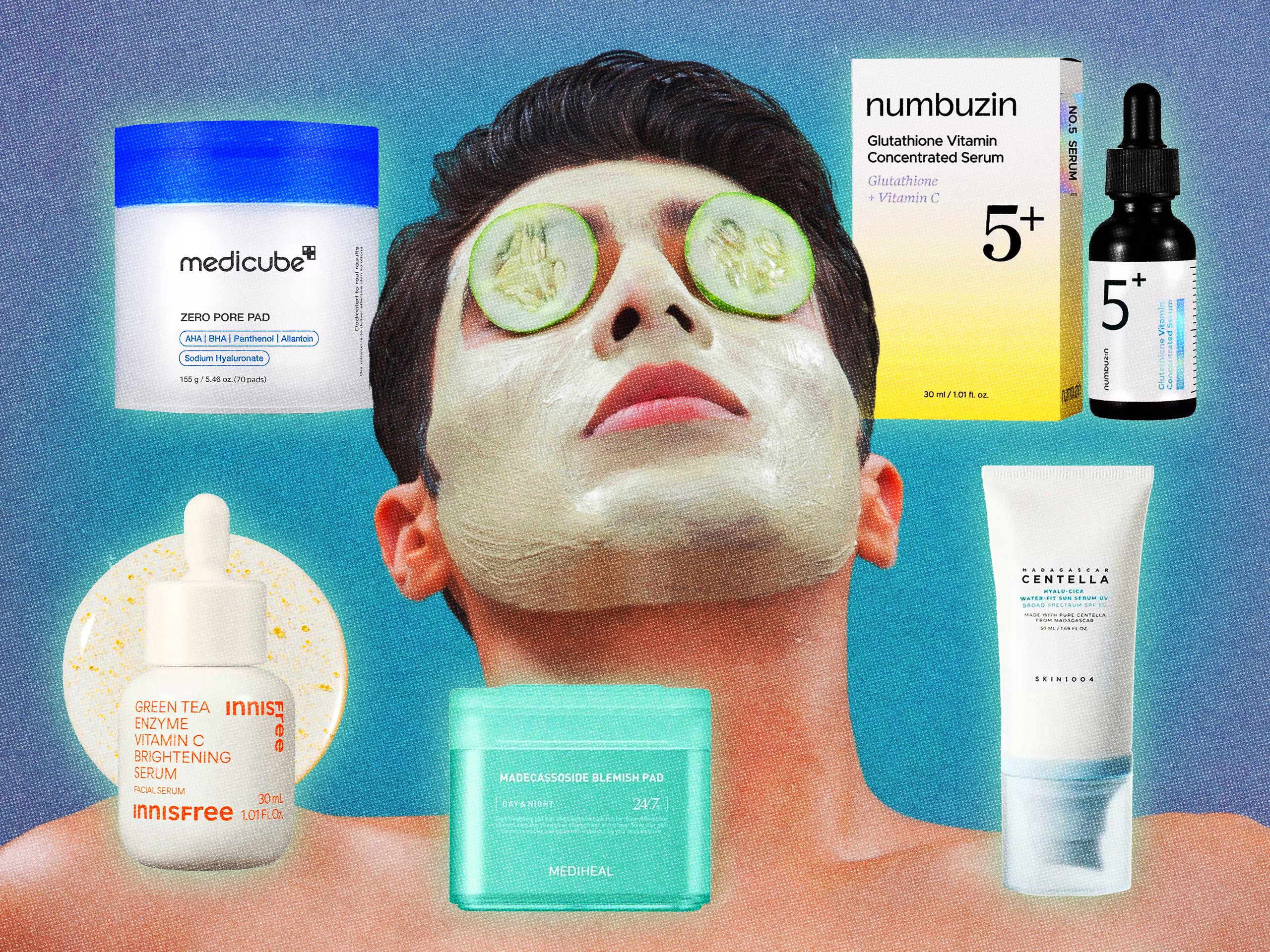
The practical barrier isn’t access – Korean skincare brands including COSRX, Innisfree, Laneige, Missha, and Sulwhasoo are available internationally, with pricing that ranges from budget-accessible to premium. The barrier is sequence. Most men start by buying products and then figuring out how to use them, which is backwards. Starting with a fixed order – cleanse, tone, treat, moisturize, protect – and selecting products to fill each slot gives the routine a structure that individual products can’t provide on their own.
The broader shift Korean grooming represents is treating the face as something that responds to consistency over time rather than occasional intervention. A daily routine that takes four minutes will outperform an elaborate one followed three times a week. That’s not a Korean insight specifically – it’s just how skin works. But Korean grooming culture built an entire industry around products designed to make that consistency genuinely easy to maintain, and that’s what makes it worth paying attention to. The question isn’t whether these techniques are worth incorporating. It’s which step has been missing the longest.