





A Wing Job Made of Willow and a Mystery That Spans Centuries
A Benedictine monk strapped on homemade wings and jumped off a tower over a thousand years ago. The recorded details of that stunt, and of what he allegedly saw in the night sky, are now at the center of a genuine scholarly dispute about dates, comets, and the limits of medieval documentation.

Brother Eilmer and the Tower at Malmesbury
Eilmer of Malmesbury did not leave a diary. What survives comes from William of Malmesbury, a 12th-century historian who wrote about the monk’s life around 1125 – roughly a century after the events in question. According to William’s account, the young Benedictine climbed the 150-foot tower of Malmesbury Abbey, wearing wings he had built himself from willow wood and cloth, and jumped. He glided approximately 600 feet, cleared the town wall, and crash-landed in a small valley near the river Avon. Both his legs broke on impact. He never flew again.
The abbey in the small English town of Malmesbury still has a stained-glass window honoring Eilmer. For a monk who attempted something that resembles hang gliding roughly 900 years before the activity became a weekend hobby, that seems like modest recognition.
William of Malmesbury described the flight as occurring when Eilmer was “in his first youth.” He also wrote that, when Eilmer was “advanced in years,” the monk watched Halley’s comet pass during its 1066 apparition and remarked, “It is long since I saw you.” That phrase – four words, essentially – is the entire basis for an ongoing argument about when Eilmer was born, when he flew, and what comet he was actually talking about.
The traditional reading goes like this: Eilmer’s comment implies he had seen Halley’s comet on a previous pass. The comet’s prior visit was in 989. If Eilmer was at least five years old in 989, he was born no later than 984, which would put him in his 80s by 1066. Under that math, his flight – described as occurring in his youth – most likely happened between 1000 and 1010. It is a tidy chain of reasoning, but it depends on assumptions stacked on top of assumptions.
A New Paper Introduces a Different Comet Entirely
James Aitcheson of the University of Leicester has published a paper in the journal Notes and Queries arguing that the comet Eilmer saw in his youth was not Halley’s 989 apparition. Aitcheson’s case centers on the comet of 1018 – a separate object, not Halley’s comet – as the thing Eilmer may have witnessed as a young man. If that reading is correct, then almost every date in the traditional account shifts significantly forward.
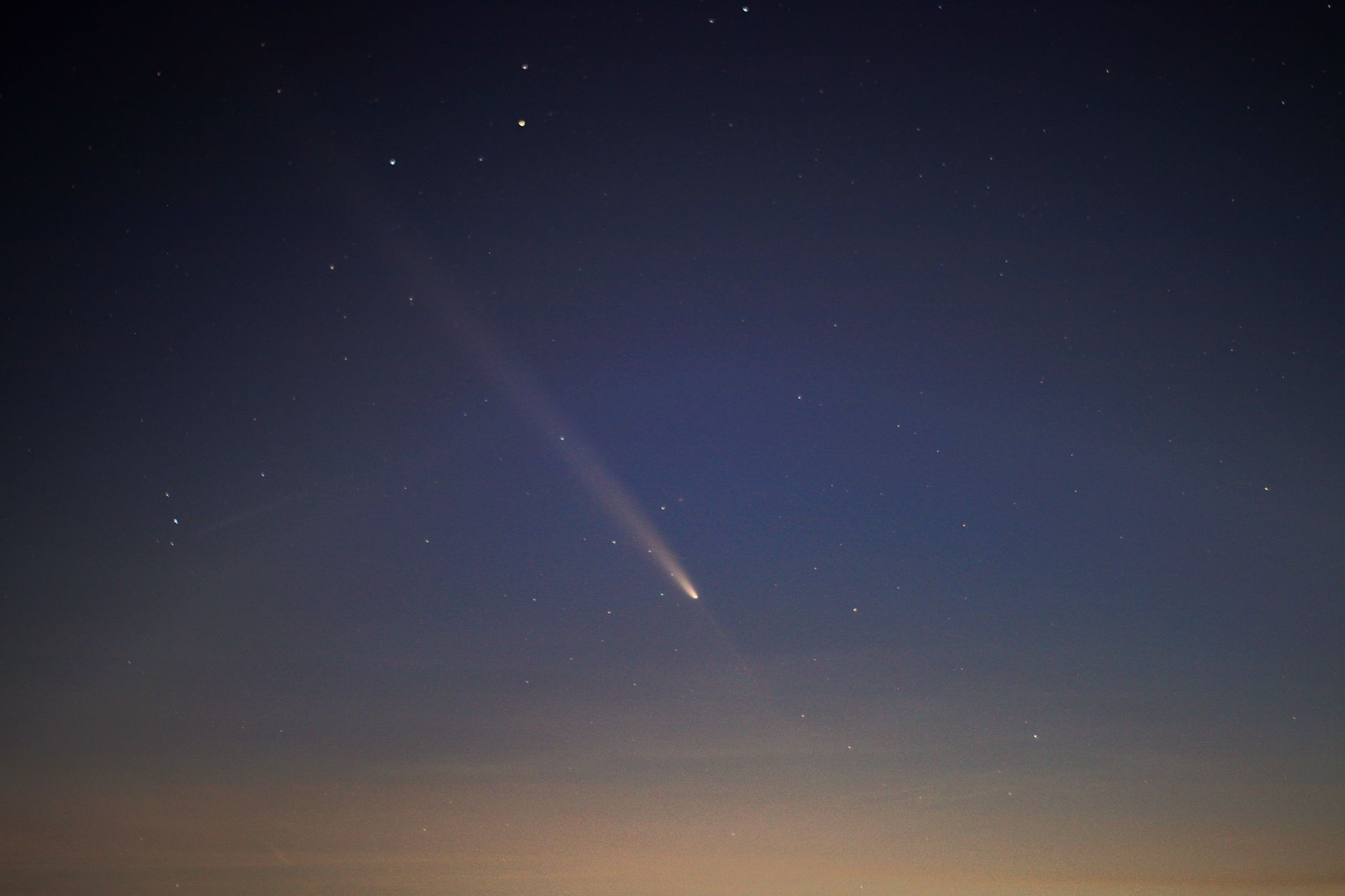
Under Aitcheson’s interpretation, Eilmer would have been born considerably later than 984. His flight, still placed in “his first youth,” would have occurred not around 1000 to 1010 but somewhere in the 1020s to 1040s. That is a gap of two to four decades – not a minor adjustment to a footnote, but a substantial revision to the timeline of one of history’s more unusual engineering experiments.
The problem is that William of Malmesbury never specifies which comet Eilmer saw as a young man, and never gives an exact year for the flight. He was writing from memory, tradition, and whatever documents or oral accounts he could gather, at least a generation after Eilmer’s death. The phrase “It is long since I saw you” is Eilmer speaking to the comet as if greeting an old acquaintance – but it does not say how long, does not name the previous comet, and does not anchor the memory to any verifiable year.
Whether Halley’s comet passed in 989 or a different, unnamed comet appeared in 1018, the core mechanics of Eilmer’s flight do not change. He built wings from available materials, he jumped from a significant height, and the result was a glide followed by a hard landing. The aerodynamic logic of what he attempted – using surface area to slow a fall and generate lift – is the same regardless of which comet he saw as a child. What the date dispute affects is how old he was when he jumped, and therefore how much time he had spent, presumably, thinking about it.
If the earlier timeline holds, Eilmer was a teenager or young adult attempting flight in the first decade of the 11th century. If Aitcheson’s reading is correct, he may have been younger still when he finally committed to the tower – or alternatively, older than the word “youth” comfortably suggests, depending on how generously one reads William’s Latin. Medieval concepts of youth did not map neatly onto modern age brackets, which adds yet another layer of interpretive difficulty to an account that is already running on thin sourcing.
Halley’s comet operates on a roughly 75-to-76-year orbital cycle. Its 1066 appearance is among the most documented in history, partly because it coincided with the Norman Conquest of England – the comet appears in the Bayeux Tapestry, stitched into the fabric of one of the most significant political events of the medieval period. Its previous appearance in 989 is also documented, though less dramatically. The 1018 comet that Aitcheson proposes as an alternative is a different object altogether, recorded in sources of the period but without anything like the cultural footprint that Halley’s carries.

What the Record Actually Allows
What William of Malmesbury gave historians is a vivid anecdote, not a logbook. He recorded the wingspan, the approximate distance, the crash, and a colorful detail about Eilmer reportedly blaming his failure on the absence of a tail – he had not built one, and he apparently believed that was the problem. William did not record a year for any of it. The astronomy, in the end, is functioning as a calendar substitute: if you can fix which comet Eilmer saw, you can fix when he was born, and from there reconstruct the rest. The impulse to use sky events as anchors for human timelines is old – and here it is doing its work on a monk who, whatever the exact year, built something out of willow sticks and decided a 150-foot drop was worth finding out.
Aitcheson’s paper does not settle the question. It introduces a plausible alternative reading and demonstrates that the traditional date range for Eilmer’s flight rests on an assumption – that “It is long since I saw you” refers specifically to Halley’s 989 apparition – that is not actually stated anywhere in the source material. Whether subsequent scholars find that argument compelling enough to revise the standard account remains to be seen, but the ambiguity was always there. The comet of 1018 had simply not been introduced into the conversation before.