





A Week of Difficult Questions in Books and Fiction
The first week of June 2026 arrived stacked with literary anniversaries, publishing controversies, and criticism that refused easy conclusions. Thomas Mann was born on June 1, 1875 – a fact that sits quietly beneath a week of essays about power, memory, and what books are actually allowed to say. The timing felt less like coincidence and more like the calendar making an argument.
What connected the week’s best writing was friction: between the writer and the state, between honesty and self-protection, between sustained reading and the conditions that make it nearly impossible. Not resolution – friction.
The State, the Page, and Allen Ginsberg at 100
The week’s most pointed irony belonged to Lit Hub’s politics coverage, which asked what a writer does when their book – specifically a book about Civil War-era censorship – gets censored by the U.S. government. The question is not rhetorical. It is a situation that actually happened, and the coverage did not soften it into metaphor or treat it as historical curiosity. Censorship about censorship is either the punchline or the thesis, depending on how cynical you are prepared to be.
Allen Ginsberg’s 100th birthday drew a long consideration from Ed Simon, who reached for Ginsberg’s particular strain of spiritual politics. Simon’s framing was direct: “Maybe it’s fair to call this mysticism, but it could also be called democracy. Because it acknowledges the fundamental, unnegotiable, and sacred reality of everyone’s inviolate existence.” A century after his birth, Ginsberg’s insistence that attention itself is a political act reads less like counterculture nostalgia and more like a position that needs defending again.
Fintan O’Toole, writing in the New York Review of Books, pulled lessons from Gulliver’s Travels into 2026 with the kind of clarity that makes Swift’s satire feel freshly uncomfortable. O’Toole’s chosen quotation carried the weight of the entire piece: “The irony of greatness for those who occupied its lower rungs is that, while it did not demand their utter subjection, it did demand their deference.” Jonathan Swift wrote that in 1726. O’Toole chose to print it now.
Honesty, Art, and One-Sided Contracts
Anne Enright, in The New Yorker, described integrity as “a way to hold the self together” – a line about personal honesty that doubles as a sentence about prose style. Her piece framed honesty as a contract that only one party signs, which is either a condition of good writing or an explanation for why so much writing fails. Zadie Smith, also in the New York Review of Books, took a harder angle: the autonomy of art is inconvenient, she argued, and it carries a force all its own. Neither writer was offering comfort. Both were describing a problem the reader is expected to sit with.
Elisa Gabbert’s essay on ekphrasis – the literary tradition of writing about visual art – ran in The New York Times and offered one of the week’s sharpest one-liners: “To write about art might encourage some removal from the self, but nothing requires it.” The history of ekphrasis is also a history of writers who used other people’s images to say things they couldn’t say directly, and Gabbert tracked that evolution without flattening it into a single thesis.
The Reading Crisis, Ragebait, and AI Explaining Itself
Tyler Jagt’s piece in The Chronicle of Higher Education named something that many people in and around academia have been avoiding naming: a “measurable, generational collapse in sustained reading and writing.” His argument was that institutions are responding with “improvisation and exhaustion rather than the structural overhaul it requires.” That phrase – improvisation and exhaustion – is doing a lot of work. It describes not just a policy failure but a posture, the specific kind of institutional fatigue that looks like adaptation but is actually drift.
Maris Kreizman, writing in Harper’s Bazaar, examined the rise of what she called “ragebait lit” – a publishing category worth taking seriously if only because it is clearly working. The genre or mode or marketing strategy, whatever it finally is, operates on the same emotional architecture as social media engagement: provocation calibrated to produce a specific kind of outrage that still sells books. Whether that makes ragebait lit cynical or just honest about how attention works is the question Kreizman was circling.
Kate Knibbs, reporting for Wired, put a specific problem on the table: Steve Rosenbaum wrote a book about how AI warps perception – and used AI assistance to produce it. Knibbs asked him to explain himself, which is the correct journalistic move. The tension between AI as subject and AI as tool has been circling literary publishing for two years, but Rosenbaum’s case made it impossible to keep at arm’s length. The explanation he gave is, by any measure, the interesting part of the story.
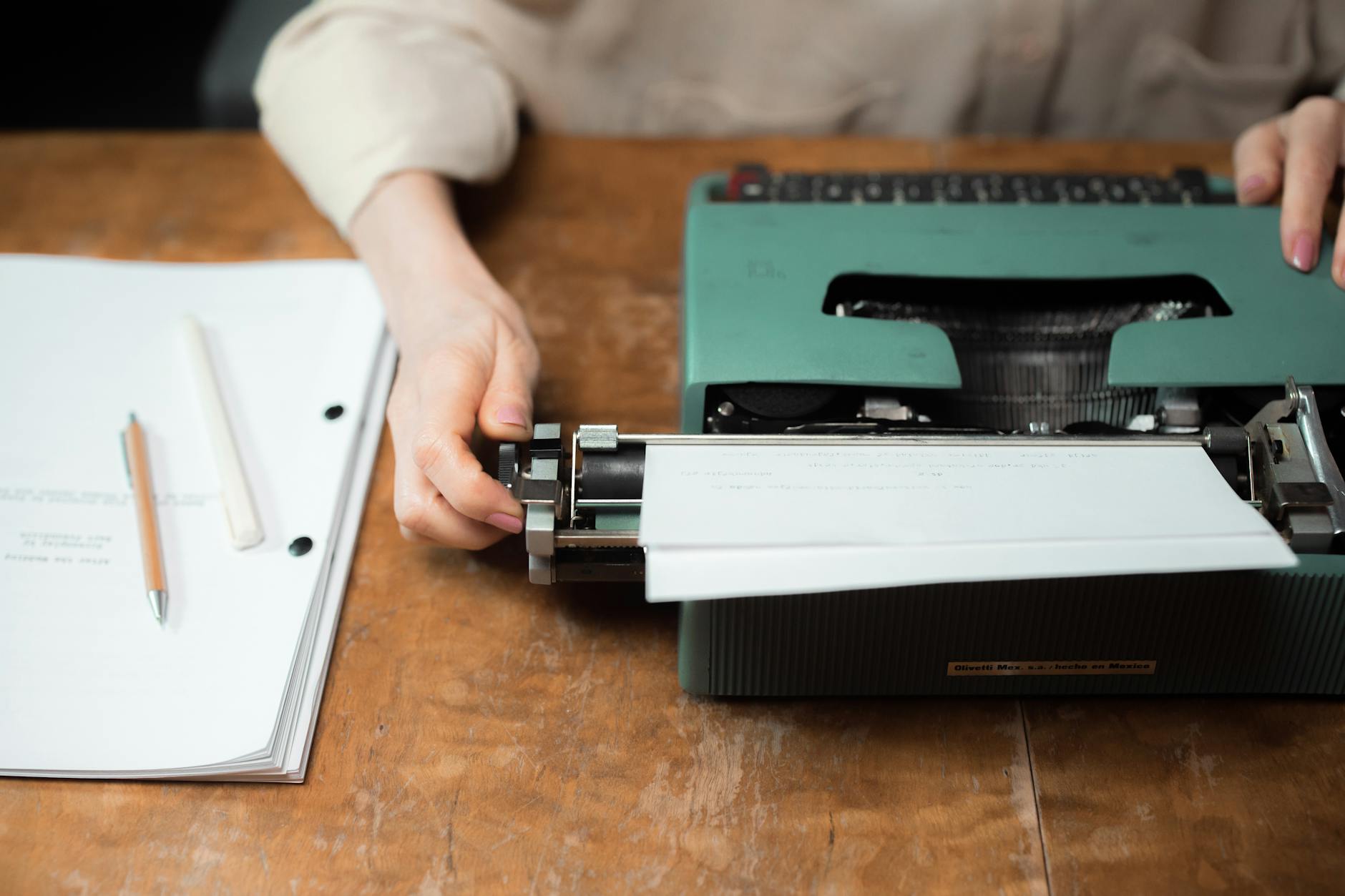
Ruth Ozeki’s remarks on typewriters, published in a Lit Hub Craft piece, cut against all of this cleanly. Her defense of the physical machine was not nostalgic: “They require a more visceral, muscular involvement in the writing process. They remind me to write deliberately, to slow my mind so that my fingers can keep up.” In a week of essays about collapsed attention spans and AI-assisted authorship, Ozeki’s preference for mechanical resistance reads less like a quirk and more like a method.
On the Shelves and in the Archives
Lit Hub’s own coverage ranged widely across the week. Carson McCullers’ The Heart is a Lonely Hunter turned up in the week-in-history section. New poetry collections for June were catalogued. Namwali Serpell and Kortney Morrow sat down to discuss Toni Morrison’s Paradise. CAConrad wrote about Eileen Myles’ poem “Bird Watching.” Ten new children’s books were flagged for summer reading. The Independent Press Top 40 Bestsellers for both fiction and nonfiction were updated.
Liz Tracey’s survey of oral histories of the AIDS crisis, published in JSTOR Daily, included a detail that stayed: Sur Rodney (Sur), a New York City-based writer, gallery co-director, and archivist, recalled that the late artist David Wojnarowicz would go to his local bodega in New York City where the clerks returned his change in a paper bag, out of fear. That image – a paper bag, a transaction, a refusal to touch – is the kind of concrete historical fact that no essay can improve on by explaining it further.
Leslie Fiedler’s longstanding doubts about the maturity of the American novel resurfaced in a New Yorker piece this week, the question posed without a clean answer. Sharon Blackie explored what fairy tales offer as grounding – specifically their structure, not their sentimentality. Four queer writers, featured in Orion, discussed aquatic life as an organizing principle in their work, which is either a metaphor or a taxonomy, and possibly both.
The week also produced a sharp, unresolved piece about a writer whose sister believes every piece of fiction is secretly about her. The question posed at the end of that essay – is she the asshole? – has no satisfying answer, which is exactly why it’s still sitting there.