




Still Here, Still Loud
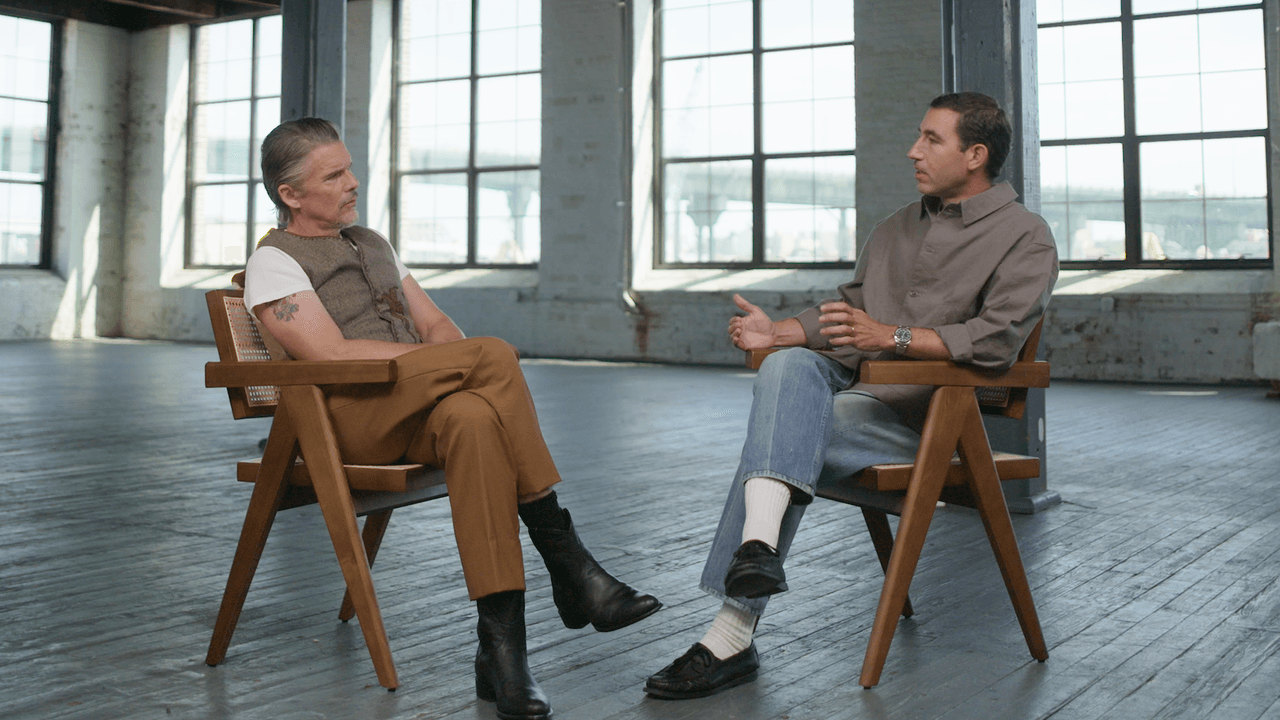
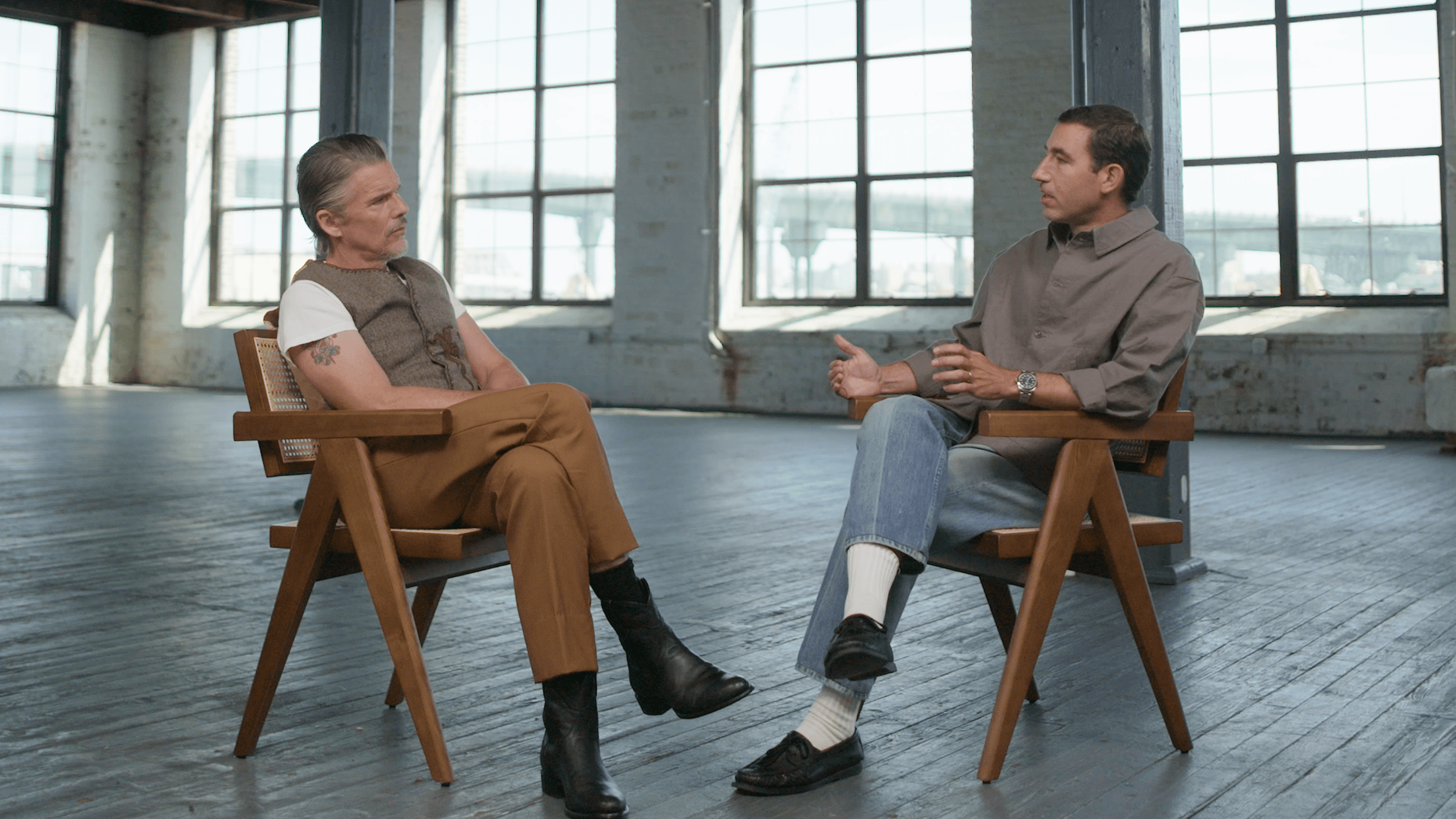
Ethan Hawke sat down with writer Zach Baron for GQ’s weekly interview series One More Question, and the conversation landed somewhere between manifesto and memoir. Hawke, currently starring in Lowdown, talked about acting as a vocation rather than a career move, about trying to build a meaningful life inside an industry that doesn’t always reward meaning, and about what it actually feels like to be the guy whose face spent a decade pinned to dorm room walls.
The interview doesn’t read like a press cycle. It reads like a man who has stopped performing sincerity and started simply being sincere – which, for Hawke, may be the same thing he’s always been doing, just without anyone paying quite this much attention to the philosophy behind it.
On Money, Control, and Who Actually Wins
Hawke didn’t mince language when the subject turned to power and commerce in the arts. “The money and the greedy bastards that think they control everybody,” he said, “they always lose in the end.” It’s the kind of line that gets dismissed as naive when you’re 24 and celebrated as earned wisdom when you’re in your 50s, and Hawke is clearly aware of that distinction. He’s been inside Hollywood long enough to have watched several cycles of suits-versus-artists play out, and he’s still standing on the same side he started on.
That conviction – that artistic integrity outlasts financial leverage – has shaped his entire body of work, from the scrappy indie energy of his early Richard Linklater collaborations to the more deliberate choices he’s made in recent years. He isn’t arguing that money doesn’t matter. He’s arguing that it doesn’t matter most. There’s a difference, and Hawke seems to live in that difference rather than just talk about it.
What the ’90s Left Behind
Ask Hawke about his status as a generational dorm-poster icon and he doesn’t deflect or perform false modesty. He acknowledges it, sits with it, and then tries to say something true about it. “The ’90s are gone,” he told Baron, “but I do feel like what’s cool about them, we carry with us.” That’s a line that deserves more unpacking than it usually gets in a quote roundup.
What was cool about the ’90s, in Hawke’s framing, wasn’t the flannel or the slacker aesthetic or the particular sonic texture of alternative rock. It was a certain attitude toward authenticity – the idea that trying too hard was the original sin, and that sincerity had to be worn lightly to mean anything at all. That ethos didn’t die when the decade ended. It just got harder to locate inside a media environment built on performance and metrics.
Hawke emerged from that decade as one of its more complicated products. He was the heartthrob who read Salinger, the Hollywood name who kept doing theater, the actor who wrote novels. None of those things made him easy to categorize, which is probably why he’s had more longevity than almost anyone who shared a magazine cover with him in 1995. Kyle MacLachlan has talked about a similar kind of durability – what happens when an actor refuses to become a fixed object, when the work keeps moving even after the cultural moment that launched it has closed.
There’s something in the One More Question format that suits him. One more question is exactly the energy Hawke operates on – the follow-up, the elaboration, the refusal to leave the conversation at the easy answer. He’s always been more interesting in the second half of an interview than the first.
Acting for the Love of It
The phrase “acting for the love of it” sounds like something stitched on a throw pillow until someone actually lives it for thirty-plus years in a business that punishes that kind of loyalty to craft over commerce.
Hawke has made that choice repeatedly, visibly, and sometimes at real cost to the kind of mainstream ubiquity that other actors from his generation chased and occasionally caught. He turned down the kind of franchise infrastructure that might have made him a different kind of famous. He kept making smaller films, kept going back to the stage, kept writing. The Lowdown press cycle is, in that sense, not a deviation – it’s a continuation of the same argument he’s been making with his career since Before Sunrise came out in 1995.
The GQ interview surfaces something that’s easy to overlook in the broader Hawke narrative: he’s not just an actor with good taste. He’s someone who has thought seriously about what it means to work in the arts at all – what obligations that work carries, what it demands from a life, and whether the trade-offs are worth it. His answer, apparently, is still yes. Not reluctantly or with qualifications, but with the kind of directness that you only get from someone who stopped needing to convince anyone else a long time ago. The greedy bastards, he says, always lose. He seems to actually believe that. Whether Lowdown proves him right again is the question the work will have to answer.