





The Wardrobe as Self-Portrait
A closet is not decoration. It is evidence – of obsessions nursed over decades, of the single silhouette a man keeps returning to, of the purchases he regrets and the ones he cannot part with. GQ opened the doors of 13 wardrobes belonging to some of the most recognizable names in music, fashion, and culture, moving through spaces that ranged from a three-story man cave to a stripped-back Parisian retreat, and what emerged was less a style guide than a kind of psychological record.
The subjects included Lenny Kravitz and Yohji Yamamoto – two men whose personal aesthetics have, over the years, become almost inseparable from their professional identities. That overlap is not accidental. It turns out the way a person organizes, accumulates, and edits their clothing says something that interviews rarely capture.
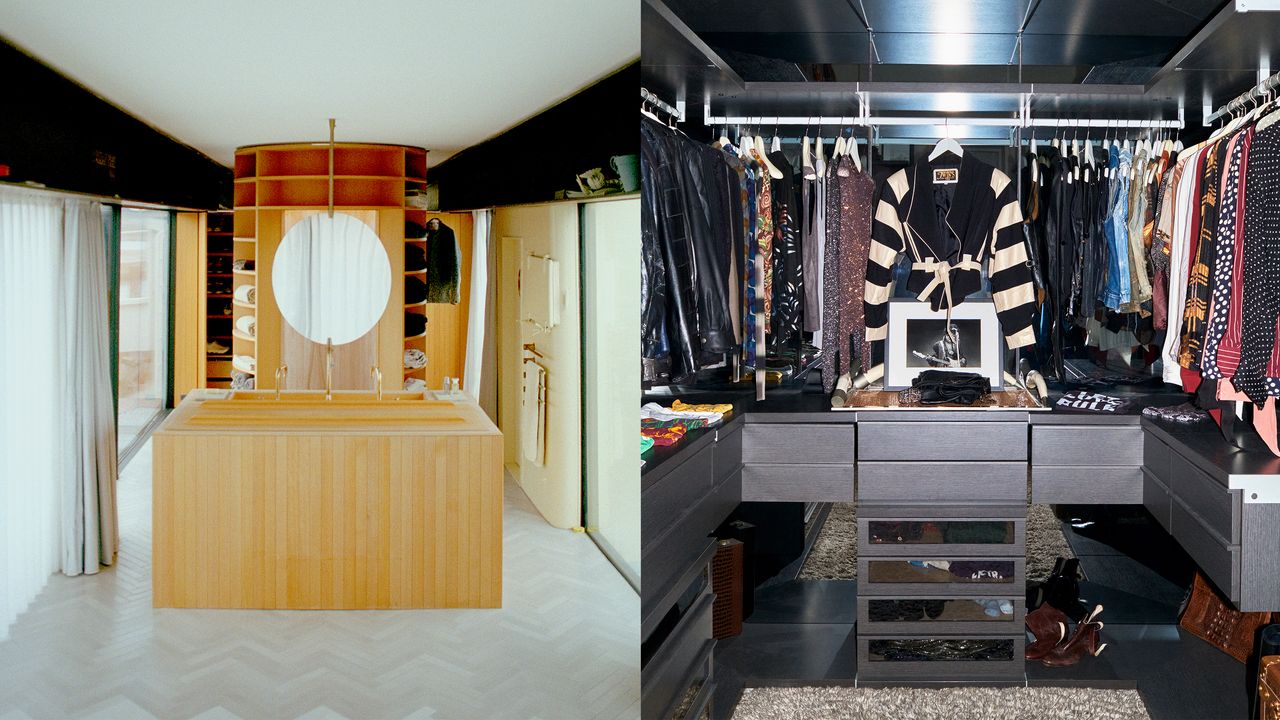
Three Stories Up and Stripped to Nothing
The physical environments themselves told contradictory stories. One closet spanned three floors – a man-cave architecture that treats clothing as collection, each piece catalogued and accessible in the way a serious library might be. The scale alone communicates a relationship with fashion that goes beyond utility. This is not dressing for the day. This is stewardship of objects that carry personal history.
The Parisian space sat at the opposite extreme. Stark, edited, and deliberate – the kind of wardrobe that only contains things that have survived a long process of elimination. Where the three-story closet accumulates, the Parisian retreat subtracts. Both approaches are, in their own way, extreme, and both reflect a deeper intentionality that most people never apply to the clothes hanging in their bedroom.
What the Clothes Actually Say
Yohji Yamamoto’s inclusion here is worth pausing on. A designer who has spent his career interrogating the relationship between clothing and identity – between construction and the body underneath – his own wardrobe is not a neutral data point. His clothes are, in the most literal sense, arguments about what clothing should do and what it should refuse to do. Seeing where and how he keeps them adds a layer to that argument.
Lenny Kravitz, meanwhile, has always worn his aesthetic like a philosophy. The wide-brimmed hats, the leather, the layering that nods at the 1970s without costuming itself as nostalgia – his closet, wherever it sits geographically, is the physical archive of a personal mythology he has been building since the late 1980s. The man does not separate his wardrobe from his identity because, for him, there is no separation to make.

What links figures as formally different as Kravitz and Yamamoto is that neither of them appears to dress reactively. They are not responding to trends, not scanning what is current and adjusting accordingly. Their wardrobes have a consistency that spans decades, which means what you see in those closets is not a shopping history – it is a worldview made fabric.
That distinction matters more than it might first appear. Most men accumulate clothes the way they accumulate anything else: opportunistically, impulsively, in response to a moment or a sale or a vague sense that something is missing. The closets GQ documented do not look like that. They look like they were built rather than assembled – and the difference between those two things is significant enough to shift how you think about your own.
Space as Philosophy
The architecture of a closet is its own argument. Three stories communicates something different from a single hanging rail in a white Parisian room, and neither is neutral. The man with the three-story wardrobe has made a spatial commitment to his clothing that requires infrastructure, maintenance, and a certain comfort with scale as a value in itself. That is not vanity, necessarily – it is more like a collector’s logic applied to wearable objects.
The stripped-back space, by contrast, demands that everything justify its presence. Nothing survives in a minimal wardrobe by accident. The edit is the point, and the discipline required to maintain it says as much about personality as any individual piece inside it.
Thirteen Doors, One Argument
Taken together, these 13 closets make a case that what a man keeps – and what he gets rid of – is more revealing than almost any other domestic detail. Not because fashion is inherently meaningful, but because the choices involved in building a wardrobe are made repeatedly, over years, under no particular obligation. Nobody forces you to hold onto a jacket for two decades. Nobody requires you to let go of one. The fact that you do either tells you something.
The world over, from man caves built to impress to retreats designed to disappear – across cultures, price points, and personal philosophies – what GQ found inside those 13 closets was not a set of style lessons. It was a set of self-portraits drawn in cloth and leather and silence. The rules men apply to their appearance rarely start at the mirror. They start much earlier, in the decisions made in the dark, before anyone else is watching.

Which raises the only question that actually matters when you open a closet door: are you looking at what you chose, or what you settled for?