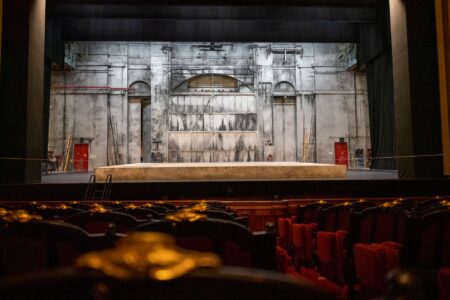





The actor known for “Inconceivable!” has theater critics reconsidering what drama looks like. Wallace Shawn’s double bill at Greenwich House Theater puts literary language center stage, challenging audiences with static staging and monologue-heavy structure that somehow creates magnetic theater.
His new play “What We Did Before Our Moth Days” runs alongside performances of his 1990 monologue “The Fever” on alternating nights.
Both works strip away theatrical convention in favor of prose-like language that reads as well as it performs.
Four Chairs, Three Hours, One Family’s Dissolution
“What We Did Before Our Moth Days” features John Early, Hope Davis, Josh Hamilton, and Maria Dizzia delivering what amounts to four separate monologues about a family’s collapse. The staging appears deliberately anti-theatrical-four actors in chairs addressing the audience directly rather than each other. No movement, minimal interaction, maximum verbal density.
Shawn developed the work with André Gregory, his collaborator since their famous filmed dinner conversation in 1981. Gregory has defended the uncommonly static design as dialectical rather than dramatic, positioning the audience as jury members weighing testimony about familial breakdown.
The approach mirrors Shawn’s broader theatrical philosophy. His characters, as George Prochnik noted in The Paris Review, “talk in terms that suggest they are presenting not just their story, but also their case.” The courtroom metaphor runs deep-each performance becomes a trial where spectators must render verdict on the evidence presented.
From Food Poisoning to Revolutionary Consciousness
“The Fever,” performed by Shawn himself on nights when “Moth Days” goes dark, follows an American tourist’s psychological unraveling from a bathroom floor during a bout of food poisoning. The 90-minute monologue weaves together childhood guilt, observations about systemic injustice, and what may be firsthand accounts of revolutionary movements in Mozambique.
Prochnik described the piece as “effectively a conversion story, from solipsism to Marxism”-a framework that could easily produce didactic theater. Joyce Carol Oates has criticized it on exactly those grounds. Yet audiences continue finding the work eerily relevant, drawn to Shawn’s dissection of bourgeois paralysis in the face of global inequality.
The timing feels deliberate. With liberal guilt reaching new heights and Marx experiencing renewed cultural relevance, “The Fever” offers uncomfortable recognition rather than comfortable distance. Shawn’s “undimmable riz” (as one critic put it) certainly helps, but the real draw may be his willingness to anatomize privileged anxiety without offering easy absolution.
What distinguishes Shawn from other writers exploring similar territory is his commitment to literary language on stage. His plays read like essays that happen to be performed. Characters rarely engage in traditional dialogue, instead delivering fully formed thoughts that could stand alone on the page.
This approach creates what Moze Halperin called “a steaming brew of Sleepytime” that somehow becomes “riveting theater.” The paradox suggests something important about contemporary drama’s possibilities. When Netflix and TikTok compete for attention spans, Shawn demands three hours of concentrated listening. When most theater relies on visual spectacle, he offers four people in chairs talking.
The son of a New Yorker editor and longtime partner of celebrated fiction writer Deborah Eisenberg, Shawn has spent decades making what he calls “knotty, ruminative plays about death and troubled institutions.” His theatrical works often feel closer to published essays than performed scripts-a quality that becomes asset rather than liability in an era when traditional publishing faces its own institutional troubles.

The Greenwich House productions raise questions about theater’s relationship to literature that extend beyond Shawn’s particular aesthetic. When plays function as well on the page as on stage, what defines theatrical experience? When monologues replace dialogue and stasis substitutes for action, what creates dramatic tension?
Critics have noted how Shawn’s approach mirrors certain contemporary fiction trends-the essay-novel, autofiction’s blurred boundaries, the rise of contemplative rather than plot-driven narratives. His theater seems to anticipate literature’s future as much as drama’s, suggesting hybrid forms that resist easy categorization.
Both shows continue their runs through the month, offering New York audiences a chance to experience what amounts to performed literature. Whether this represents theater’s evolution or its retreat from theatrical essence remains an open question-one that four chairs and three hours of uncompromising language refuse to answer easily.