




Getting High on High Art
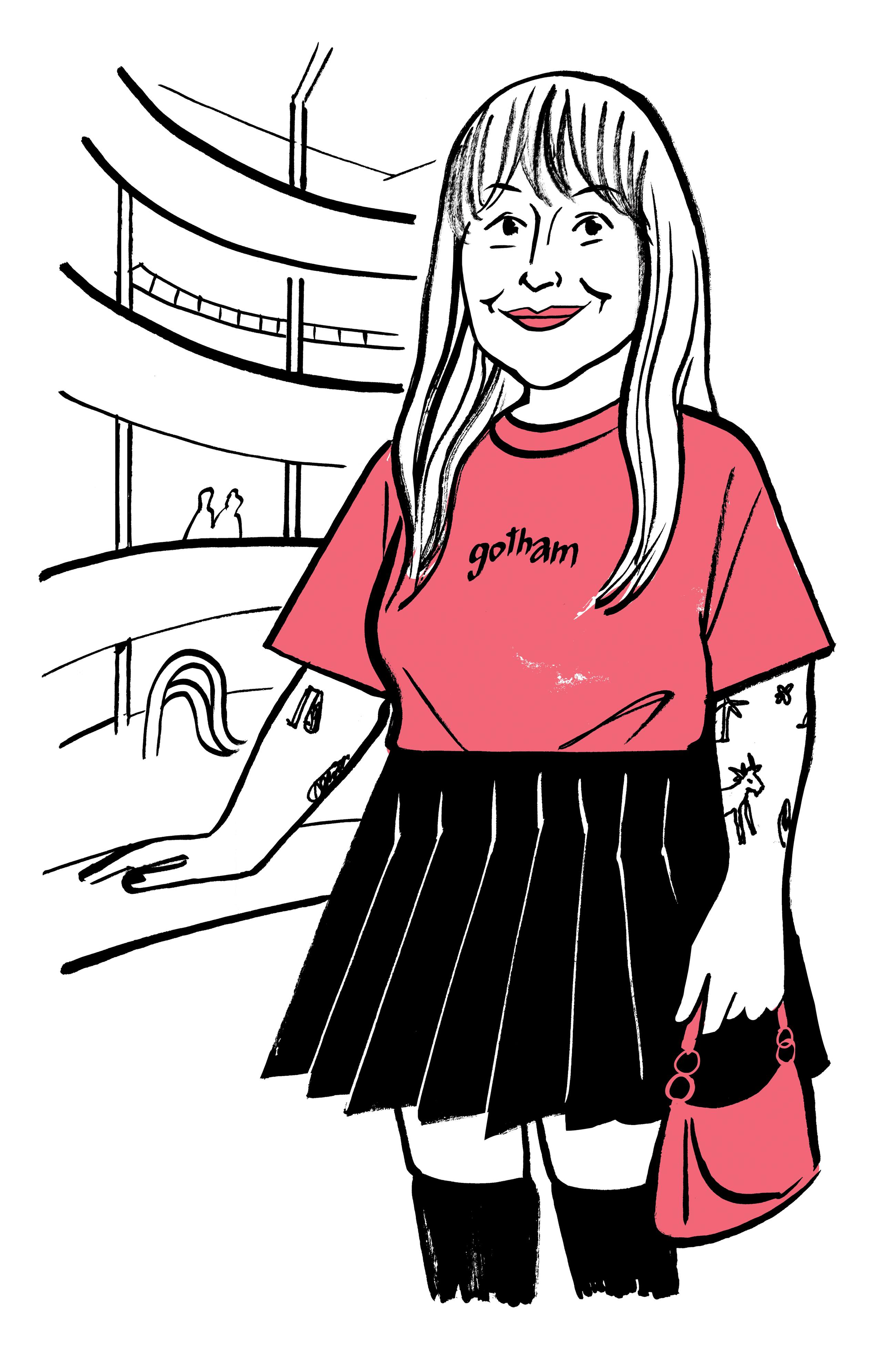
Rachel Bell has a job title that would have been impossible to print in a mainstream magazine five years ago: content director for Gotham, a New York City weed dispensary. Her primary output is a video series called Hi, I’m High, in which she gets stoned and visits New York City landmarks, then talks about what she sees. It is exactly as chaotic and considered as it sounds.
The series has taken her to some of the city’s most recognizable institutions, most recently the Guggenheim Museum – Frank Lloyd Wright’s spiral on Fifth Avenue, a building so architecturally aggressive that the art inside it has always competed for attention with the walls themselves.
She walked in already high and left with opinions.
What Happens When You Critique Sculpture Stoned
Bell’s visit to the Guggenheim was not a stunt performed in a vacuum. It was a produced segment for Hi, I’m High, a series that sits somewhere between gonzo journalism, art criticism, and the kind of unscripted commentary that tends to go viral because it says out loud what sober people whisper. At the Guggenheim, she worked her way through the museum’s collection and offered critiques of what she described as kooky sculptures – a word that, depending on your relationship to contemporary art, is either a dismissal or a perfectly accurate description of what a lot of it looks like to first-time or chemically altered viewers.
There is something worth taking seriously underneath the premise. Altered states have a long, documented relationship with how people process visual art. The loosening of categorical thinking, the heightened sensitivity to texture and form, the tendency to sit with something longer than usual – these are not trivial effects, and Bell’s series exploits them for comedy while occasionally landing on something that functions as genuine observation. Whether a stoned take on a modernist sculpture is criticism or entertainment depends largely on whether you think those two things are mutually exclusive.
The Guggenheim visit also gives Bell a particularly loaded backdrop. This is not a neutral gallery. The building’s design was controversial when it opened in 1959, and curators have spent decades negotiating between Wright’s architecture and the demands of showing flat paintings on curved walls. Bringing a dispensary’s content director into that space and letting her react without an art history script is, at minimum, a different kind of engagement with the institution.
A Career Path That Defies a Straight Line
Bell has described her own career trajectory as trippy, which is doing a lot of work as a descriptor but is also probably accurate. The legal cannabis industry in New York has created an entirely new category of media job – one that requires someone comfortable enough with the product to consume it on camera, credible enough to carry a series, and savvy enough to understand that the content has to function across platforms where the rules around cannabis advertising remain genuinely complicated.
Gotham, the dispensary behind the series, is operating in a market that only came into full legal existence recently in New York State. The content strategy of sending your director to landmark institutions – stoned, on camera, publishing the results – is either a very confident read of the cultural moment or a calculated bet that the novelty of legal weed in New York still has enough friction to generate attention. Probably both.
Bell’s role also reflects something specific about how cannabis brands are trying to position themselves in a city like New York, where the competition is dense and the consumer is not particularly easy to impress. The series doesn’t sell a product directly. It sells a sensibility – curious, irreverent, willing to stand in front of a sculpture at the Guggenheim and say it looks kooky without apologizing for the read.
The Guggenheim as Backdrop, Not Destination
What the Guggenheim visit clarifies is that Hi, I’m High is using New York’s cultural infrastructure as a kind of stage. The landmarks are not the subject; Bell’s reaction to them is. The city functions as a prop – a very expensive, historically loaded prop – against which Gotham’s brand gets to look spontaneous and culturally literate at the same time. It’s a specific kind of content strategy that depends on the weight of the institution lending credibility to the irreverence happening inside it.
That tension – between the prestige of the location and the deliberately unpolished nature of the content – is what makes the series function. If Bell were doing the same thing in a strip mall, the comedy would collapse. The Guggenheim, with its rotunda and its permanent air of self-importance, is load-bearing in a way that a less freighted venue wouldn’t be.

The New Yorker profiled Bell in its August 24, 2026 issue, which is itself a kind of cultural timestamp. A dispensary content director getting stoned at the Guggenheim for a video series was, apparently, a story worth 800 words in a magazine that has historically covered the art world with a great deal more sobriety. Whether that says more about where cannabis culture has arrived or where the New Yorker has, Bell’s next landmark visit will probably settle nothing – and will likely get more views than this sentence ever will.