




The Heat Is Not the Enemy
Every summer, the same logic takes hold: strip down, simplify, wear the least amount of clothing that social norms will allow. It’s a reasonable instinct. It’s also, increasingly, the wrong one – at least according to the men who consistently dress better than everyone else at any outdoor gathering, rooftop, or shoreside lunch you’ve attended in the last few years.
The best-dressed men right now are adding layers in July.
That’s not a provocation for its own sake. Camp shirts worn open over tanks, polos doubled up, shirts tied at the waist, waistbands of boxers riding above the trouser line – these are the specific moves that define how a certain stripe of well-dressed guy approaches summer, and they work precisely because they run against the reductive idea that warm weather demands minimalism. What’s happening instead is a kind of deliberate volume: more fabric, more intention, more personality packed into a season that usually flattens everyone into the same rotation of plain tees and shorts.
Three Moves, Done Right
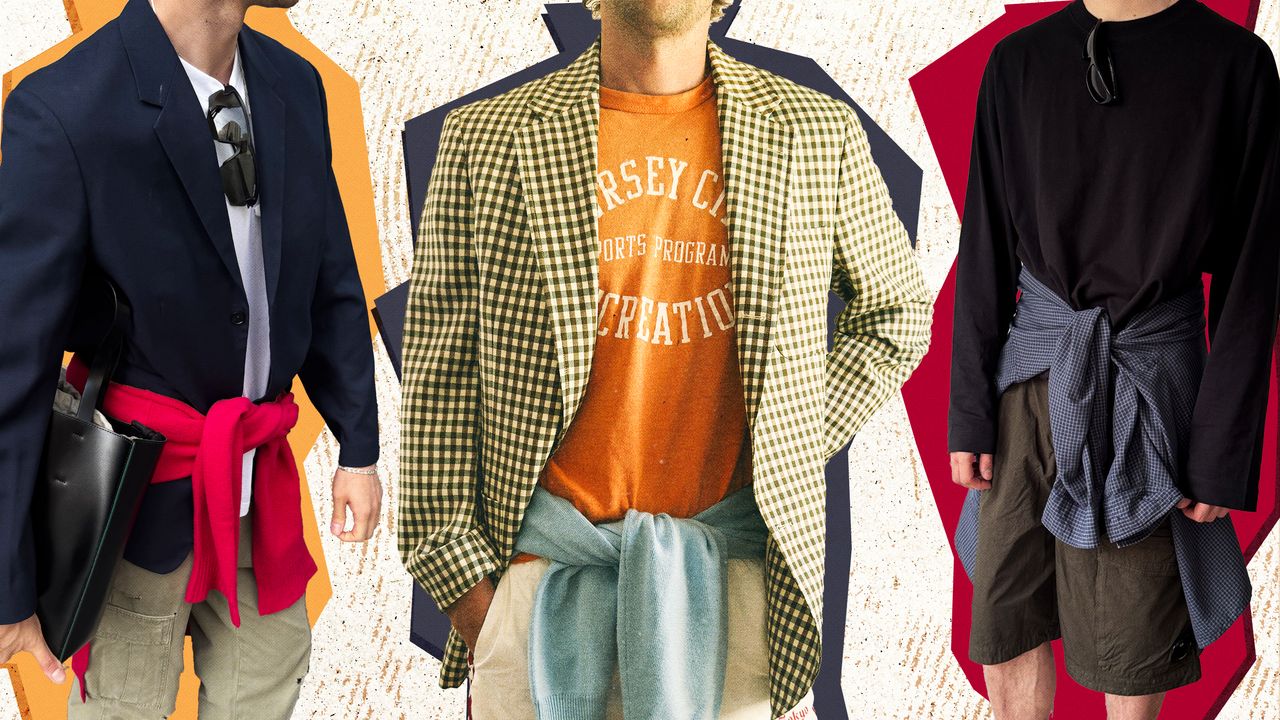
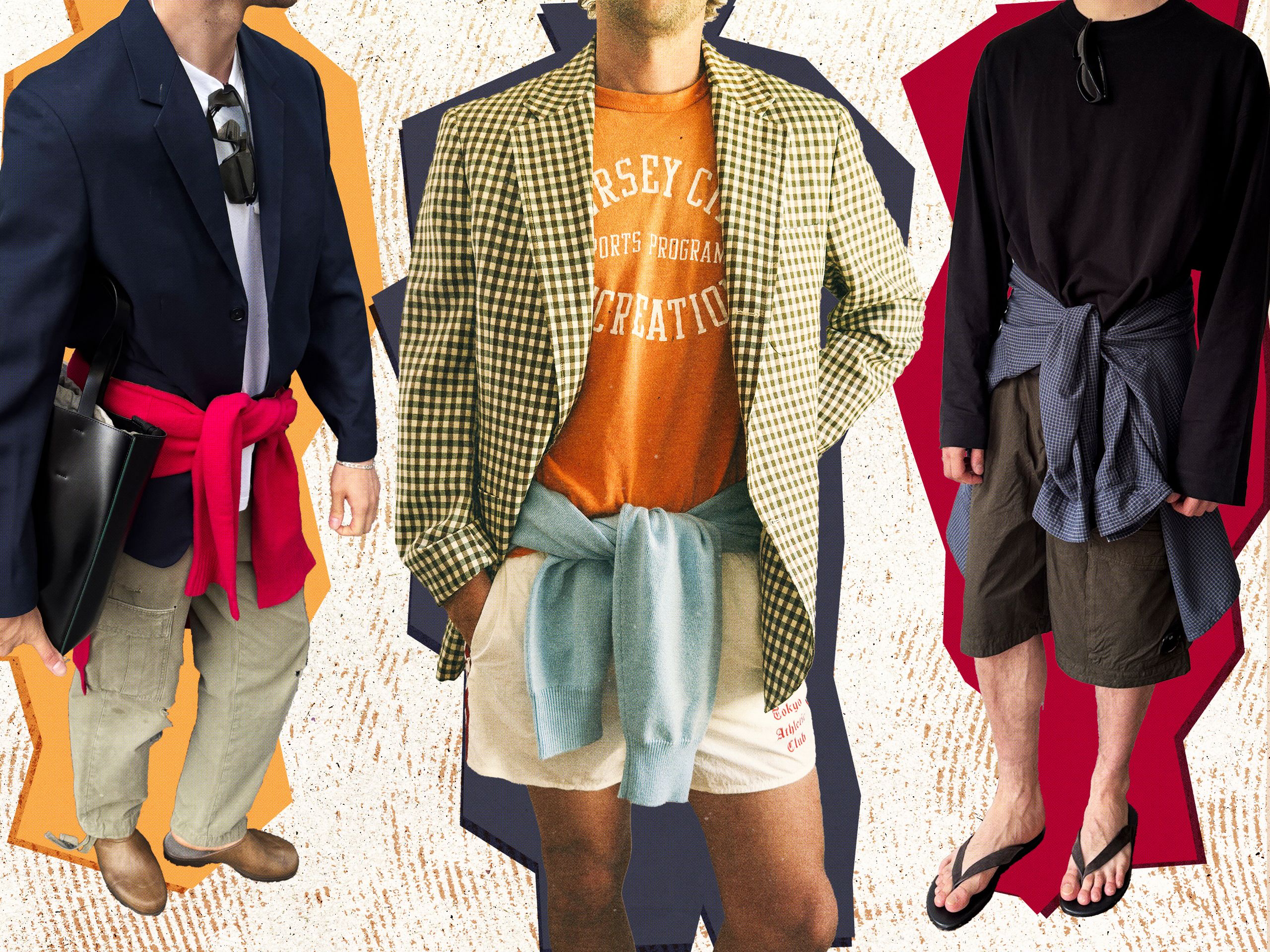
Start with the shirt tied around the waist, which sounds like a relic of 1994 but lands entirely differently when the shirt in question is something worth looking at – a printed camp shirt, a washed Oxford, a bowling shirt with contrast stitching. The tie isn’t the point. The shirt is. When the overshirt is interesting enough to stand on its own, wearing it off the body becomes a choice rather than a shortcut, and that distinction shows. It adds visual weight to the lower half, breaks up a silhouette that might otherwise read as too simple, and signals that the person wearing it thought about what they were doing when they got dressed.
The double polo is a harder sell on paper and a better payoff in practice. Layering two polo shirts – the classic method being a fitted one underneath with a looser one on top, collar sitting over collar – creates a textural conversation between two pieces that would otherwise be unremarkable on their own. Color matters here more than anywhere else in the outfit. A navy over a white reads nautical and clean. A chocolate over a cream reads something more considered. The combinations that fail are usually the ones where both polos are competing for the same space in the same tonal range, leaving the whole thing looking like an accident rather than an edit.
Exposed boxers – specifically the waistband – are the move that gets the most resistance and produces the most results when executed with any real attention. The difference between boxer waistband as style and boxer waistband as neglect comes down almost entirely to fit everywhere else. Trousers or shorts that sit slightly lower, a tucked or half-tucked shirt above, proportions that feel deliberate – those are the conditions under which this reads as intentional. Without them, it reads as someone who got dressed in the dark.
Why Camp Shirts and Tanks Aren’t Enough Anymore
Camp shirts and tanks remain genuine summer staples – there’s no argument to be made against either of them functioning well as individual pieces. A good camp shirt in a strong print, worn open over a plain white tank, is still one of the most reliable combinations available to anyone who wants to look like they know what they’re doing without spending much time thinking about it. That formula works. It has worked for years.
The problem is saturation. When a combination becomes the default answer for a certain type of dressed-up-but-casual summer occasion, it stops communicating anything specific about the person wearing it. It communicates category membership – “I am someone who is aware of menswear” – rather than actual point of view. The men who are dressing most distinctively right now have moved past the camp shirt and tank as a destination and started treating it as a starting point, something to build on or away from rather than something to arrive at.
Layering in heat demands a different kind of commitment than layering in cold weather. In winter, the logic is functional first, aesthetic second. In summer, the logic flips completely – you’re adding fabric in spite of the temperature, which means every layer needs to justify its presence more aggressively. A shirt tied at the waist needs to be a shirt worth tying. A second polo needs to be a polo worth doubling. The stakes of a bad choice are higher because the choice itself is more visible, more explained by intention and less by circumstance.
What Actually Separates the Good from the Obvious
Proportion is doing the heavy lifting across all three of these moves. A shirt tied around the waist on a man wearing a very fitted top and very slim bottoms looks mismatched and frantic. The same shirt on someone whose silhouette has a little more room – a slightly relaxed short, a boxy tank – reads as part of a considered whole. Double polos fall apart when both pieces are either too tight or too loose without variation between them. The waistband moment collapses if the trousers don’t sit in the right place relative to the shirt length above.
None of this requires buying anything new. The moves described here are all things that require rethinking what’s already in a wardrobe rather than adding to it. A polo most people own. A second polo most people own. A shirt that can be tied most people own. The boxers are already there. The investment is entirely in attention – noticing how pieces interact, experimenting with combinations that feel counterintuitive, and being willing to look slightly more put-together than the situation technically demands.

That last part – dressing with more intention than the occasion requires – is the actual throughline connecting all three moves. It’s what separates the men who consistently look good at summer occasions from the ones who look appropriate. Appropriate is easy. It’s the floor, not the ceiling. A shirt tied around the waist is a small, almost trivial gesture, but it asks something specific: do you trust yourself enough to wear something that might read as too much, knowing that “too much” is usually just “more interesting” seen from a distance?
Whether the exposed waistband ever fully escapes its associations with early 2000s teen mall culture is an open question – one that depends almost entirely on whether the people wearing it can outrun the reference.