




A Career Built on Emptiness
Tom McCarthy has spent decades writing novels that treat character, plot, and psychological depth as problems to be avoided rather than goals to pursue – and for a long time, that strategy produced genuinely strange and original fiction. His newest book, The Rhyl Poster, suggests the strategy may have finally run out of road.
The Architecture of Refusal
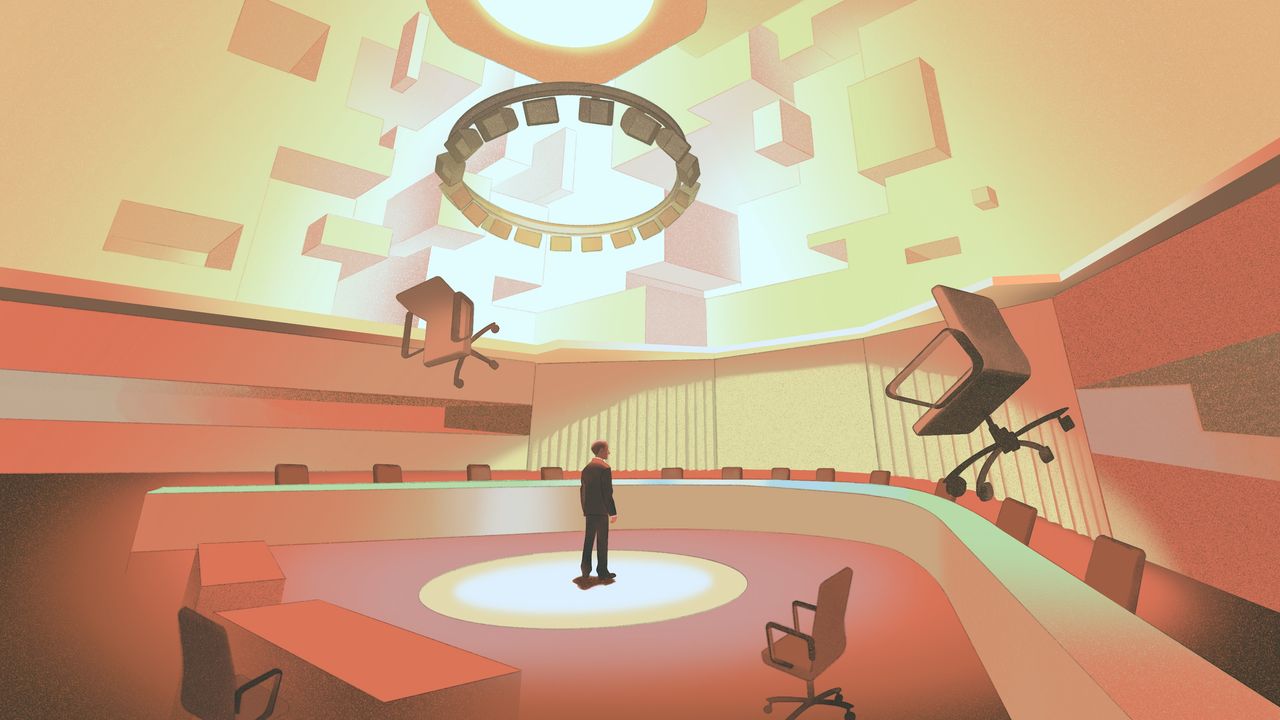
McCarthy built his reputation by systematically dismantling the conventions of realist fiction. Where traditional novels anchor themselves in individual psychology – in the belief that inner lives are worth mapping, that characters carry meaning – McCarthy’s work treats those assumptions as naive, even dishonest. His protagonists are not people so much as positions: hollow figures moving through systems too large and too indifferent to acknowledge them. It is a literary posture borrowed heavily from the European avant-garde, and McCarthy has always worn that debt openly.
His breakthrough novel Remainder established the template. Its unnamed narrator, flush with settlement money after an accident he cannot remember, becomes obsessed with staging and restaging elaborate re-enactments of ordinary life – hiring actors to repeat mundane gestures endlessly in a building he controls. The compulsion to repeat, to drain action of spontaneity and feeling, was both the book’s subject and its method. McCarthy was making an argument: that authenticity in fiction is a con, that the realist novel’s emotional payoff is a trick performed on credulous readers.
That argument carried real force. Remainder was shortlisted for prizes and talked about in serious literary circles. C, his 2010 novel, went further, following a protagonist named Serge Carrefax through early-twentieth-century history – wireless telegraphy, World War One, Egypt – in a narrative structured around signal and noise, transmission and static, rather than around anything as conventional as emotional development. McCarthy was not building a career so much as assembling a theoretical position across successive books, each one testing how far the realist novel’s furniture could be cleared away before readers stopped showing up.
The short answer, based on his readership, was: quite far. There is an audience – literary, academically inclined, comfortable with difficulty – that finds McCarthy’s approach not cold but clarifying. When everything sentimental is stripped out, what remains is a kind of structural honesty about how systems – bureaucratic, technological, historical – process human beings without caring much about the results. For that audience, the emptiness is the point. The Rhyl Poster now tests how much patience even that readership has left.
What “The Rhyl Poster” Does and Doesn’t Do
The new book continues McCarthy’s central preoccupation: mysterious individuals caught inside byzantine systems, unable to locate meaning or exit. His figures do not grow, do not arrive at understanding, do not resolve. They move through structures – institutional, symbolic, procedural – that grind on regardless of their presence. That much is familiar. What the New Yorker‘s review of the book identifies is something more troubling: that the approach may have hit its ceiling.
The critique is not that McCarthy’s method is wrong, exactly. It is that a method applied without variation across decades eventually stops functioning as critique and starts functioning as habit. There is a difference between a novelist who refuses psychological realism because he has reasons – philosophical, formal, political – and a novelist who refuses it because that is simply what he does now. The risk McCarthy runs with The Rhyl Poster is that the dismantling of realist tropes, once a provocation, has become its own kind of convention.
This is a specific problem for writers who position themselves against mainstream fiction. The avant-garde gesture requires an establishment to push against. When the gesture itself becomes expected – when readers arrive already knowing that McCarthy’s characters will be opaque, his plots deliberately frustrating, his resolutions withheld – the friction that generated meaning in earlier books starts to dissipate. Difficulty stops being difficult. Opacity stops being provocative. The form that was meant to resist readerly comfort becomes, paradoxically, a comfort of its own for the readers who have learned to appreciate it.
McCarthy’s mysterious individuals – trapped, purposeless, absorbed into systems that exceed their comprehension – have always functioned as stand-ins for a broader argument about modern subjectivity. The idea is that the coherent, self-determining individual of the Victorian novel was always a fiction, and that contemporary life, with its bureaucratic and technological entanglements, makes that fiction impossible to sustain. It is a reasonable argument. But arguments made through fiction need to do more than restate themselves. They need to find new pressure points, new forms of discomfort. The Rhyl Poster, by the account of those who have read it closely, may not find them.
What the title itself signals is worth noting. Rhyl is a seaside town in north Wales – unglamorous, post-industrial, the kind of place that accumulates a certain kind of British melancholy almost automatically. A poster is a surface image, something designed to represent a place to people who are not there, to substitute a clean version of a location for the complicated reality. That McCarthy chose this as his central image suggests he is still interested in the gap between representation and reality, between the systems that package experience and the experience itself. Whether the book does something new with that interest is the question his critics are now pressing.
It is also worth noting what McCarthy is not doing. He is not writing psychological character studies with unconventional structure, in the manner of, say, Rachel Cusk. He is not reaching for the maximalist density of a David Foster Wallace. He occupies a specific and narrow lane – formally experimental, theoretically grounded, emotionally arid by design – and that narrowness is both his strength and, at this point in his career, his constraint. The lane is not getting wider.
Where the Method Meets Its Limit
The deeper question The Rhyl Poster raises is whether a literary project defined by negation – by what it refuses to do – can sustain itself indefinitely without some form of renewal. McCarthy’s negative capability, his insistence on withholding the consolations of realist fiction, was generative for years because it said something about what those consolations cost, what they required readers to ignore. A novel that makes you feel understood does so partly by narrowing the world to fit your expectations. McCarthy’s novels never do that. But the challenge of that refusal has to come from somewhere, and after decades of the same structural commitments, the challenge risks becoming rote.

There is a line, not always easy to locate, between a novelist who has developed a distinct and consistent vision and one who is repeating himself. McCarthy’s defenders would argue he has never crossed it, that each book finds new material for the same essential machine. Readers who track literary fiction closely will disagree about where The Rhyl Poster falls. But the fact that the question is being asked this insistently, that reviews are framing the book as a possible limit case for his entire approach, suggests McCarthy has arrived at a genuinely uncertain moment in his career – not a failure, but a pressure point that his next move will need to address.