


Leo Tolstoy died on this date in 1910, 116 years ago, and the literary internet has not stopped arguing about what a writer owes the page since. Lit Hub’s daily roundup for November 20, 2026 opens with the anniversary and then wanders, as it usually does, through writer’s block, medieval crime fiction, a Yellowstone co-creator’s prison manual, and a poll worker’s memory of her grandmother.
Read together, the sixteen or so items are less a news digest than a map of what working readers are thinking about right now. Fiction sits in the middle, and around it are questions of who gets credit for a sentence, what a book can do under political pressure, and how long a story can keep repeating itself before it becomes something else.
Reading as the Cure for a Stalled Draft
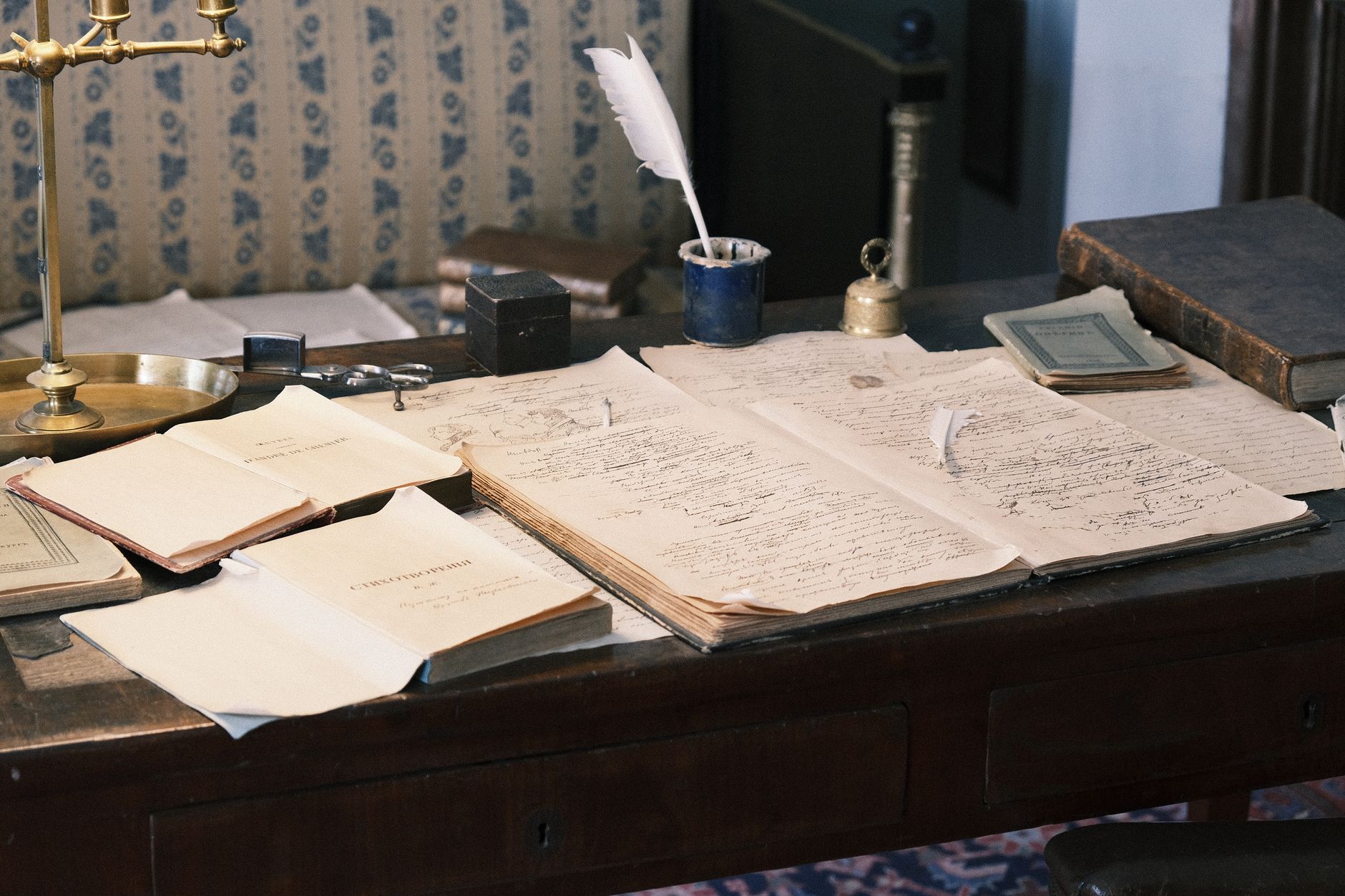
The most practical piece in the batch asks how this year’s National Book Award finalists get past writer’s block. The answer, per the headline, is reading, “obviously.” It is a modest answer, and a useful one. Finalists are presumably the people with the least excuse for a dry spell, yet they treat the shelf as the first tool and the keyboard as the second.
The surrounding lists pull in the same direction. One makes the case for “pure originality” with novels by Samuel Beckett, César Aira, Christine Brooke-Rose, and others. Another, from Reed Turchi, collects poetry on music from Ellen Bryant Voigt, Nikky Finney, Michael Ondaatje, and more. A third argues that fiction and family drama are natural partners, and it poses the question that explains why: “Where do we learn how to love and negotiate, compromise and persuade, if not from the family unit?” Each list gives a stuck writer a different door. One offers the strangest possible models, one a cross-disciplinary ear, and one the oldest raw material there is, the kitchen table.
Stories Under Pressure
The fiction on offer today tends to put characters in tight spaces. Ariel Dorfman’s story “Blank,” from his new collection What She Saw, runs in Lit Hub Fiction, and its excerpted line is bleak and precise: “The members of the firing squad have been selected, the rifles are ready to be loaded, as soon as the day dawns and the grave is dug, it will be my turn to act.” The narrator is waiting, procedure is already in motion, and the sentence moves with the same inevitability.
Time itself becomes the confining space in Eric Dean Wilson’s essay for Broadcast. He starts from Solvej Balle’s On the Calculation of Volume and works back to Groundhog Day, asking what stories about looping time can teach us about what comes next. The looping-day premise has become a durable shape for fiction because it removes the usual escape hatch of plot. Nothing advances, so character has to.
Then there is the odd one out. Hope Corrigan, writing in The New Republic, reads a Yellowstone co-creator’s “inexplicable prison survival guide” and wonders, in a line that doubles as a review: “Who exactly is committing the entirety of this book to memory before they get hauled off to prison?” It is a funny question, and it shows how much a book’s premise depends on a reader who does not exist. Not every volume that promises to save you from a bad situation has thought about the person who would actually be in it.
CrimeReads adds a genre angle with a list of medieval mysteries, thrillers, and horrors, including titles by M. T. Anderson, Ferdia Lennon, and Indrek Hargla. Those who like their dread with a long historical runway will find a shelf there. Separately, the week’s best-reviewed books per Book Marks include Gary Shteyngart’s The Sensualist, Nick Harkaway’s The Taper Man, and Hermione Lee’s Anita Brookner: Art and Life. A satirist, a novelist with a taste for the uncanny, and a major literary biographer all landed in the same week, which makes for an unusually varied set of critical wins.
Where Books Meet the Street
Not everything in today’s batch is about the imagination. Steven W. Thrasher, in Lit Hub Politics, writes about medical racism and about what happened when ICE blocked access to the emergency room at Adventist Health White in Los Angeles. The piece sits in a literary newsletter because Thrasher writes about health and power as a book-length subject, and because the story shows how institutions can close a door that is supposed to stay open.
Margaret McMullan comes at politics from the other end of the process. An author and a Mississippi poll worker, she reflects in Ms. on Scott Colom’s historic Senate race win and on her grandmother’s unwavering politics. The pairing of a recent election result with a family inheritance is the kind of personal-political essay that works because it keeps the camera low, at the level of a folding table and a stack of ballots.
History gets its turn too. In Lit Hub History, Paul French chronicles the fall of Puyi and Wanrong, China’s last emperor and empress. It is a story about a court that ended, and about two people who had to live on after the ceremonies were over. Andrey Zvyagintsev, meanwhile, talks to CrimeReads about making his latest film, Minotaur, a reminder that the literary crowd’s appetite for dark, labyrinthine narrative extends to cinema.

Who Gets to Be Called Original
Maggie Shipstead’s piece for T Magazine is the quietest in the lineup. She spent her 43rd birthday trekking in the Yukon, and she uses the trip to consider what it means to embrace aging and “wear your years as a crown.” A novelist known for big canvases narrows her focus to one body, one trail, and one birthday, and the effect is a useful counterweight to a day dominated by firing squads and prison manuals.
Claudia Brodsky’s tribute in Public Books recalls Toni Morrison as a collaborator and a friend. “Toni and I had the same fundamental feeling about language as a capacity,” Brodsky says. “It was the crux of everything for us.” That sentence is a better defense of literary originality than most of the lists above, because it locates originality in a way of treating words as a power to be used, not a style to be copied.
It also sets up the sharpest argument in the roundup. Mitchell S. Jackson, in Esquire, writes about AI writing accusations “casting doubt on the possibility of Black literary brilliance.” Set beside a list of novels praised for “pure originality,” and beside an essay on a writer whose command of language was never in doubt, his point lands hard. If suspicion of machine-made prose falls unevenly on some authors, then who is presumed capable of a voice of their own?