





The Workout Philosophy Quietly Taking Over Gym Floors
Full-body training – the practice of working every major muscle group within a single session – has moved from rehabilitation clinics and athletic programs into the mainstream fitness conversation, backed by its documented benefits for functional fitness and long-term physical health.

Why Training Everything at Once Actually Works
The appeal of split routines – chest on Monday, legs on Wednesday, arms on Friday – made a certain kind of mechanical sense. Isolate the muscle, exhaust it, let it recover. For decades that model dominated gym culture, particularly among bodybuilders chasing hypertrophy and the kind of symmetrical mass that photographs well under competition lighting. But isolation training was never designed with longevity in mind. It was designed for aesthetics, and the two goals are not always aligned.
Full-body workouts operate on a different premise entirely. Rather than treating the body as a collection of separate parts to be developed independently, the approach treats movement as integrated. A squat isn’t just a quad exercise – it pulls in the glutes, the hamstrings, the core, the lower back, and depending on how the load is held, the shoulders and arms as well. That coordination isn’t a side effect. It’s the point. Training muscles to work together mirrors how the body actually moves through daily life, which is why the approach connects directly to functional fitness.
Functional fitness refers to the body’s capacity to handle real-world physical demands – carrying groceries up stairs, recovering balance on an uneven surface, lifting something heavy from the floor without injury. These aren’t athletic feats. They’re the baseline physical competencies that determine quality of life across decades, and they tend to erode quietly when training focuses exclusively on isolated muscle groups that never learn to cooperate. Full-body programming maintains those movement patterns by reinforcing them consistently, multiple times per week, across a range of exercises that require whole-body coordination.
The connection to longevity follows directly from this. Maintaining functional strength into later decades isn’t about lifting heavy weights or sustaining an athletic identity – it’s about preserving mobility, stability, and the neuromuscular patterns that prevent falls, reduce injury risk, and keep the body capable of independent movement. Full-body training builds and maintains exactly those qualities. It also tends to keep the mind more engaged during sessions, since compound movements demand more coordination and attention than isolation exercises performed on a fixed machine.
Five Expert-Approved Exercises That Do the Work
The exercise selection within a full-body program matters considerably. Not every movement delivers equal return across the body, and the five exercises identified by fitness experts as foundational to this training style share a common quality – each one demands meaningful input from multiple muscle groups simultaneously, which is what separates them from filler movements.
The squat is the most fundamental of the group. Whether loaded with a barbell, held with a dumbbell at the chest, or performed with bodyweight alone, the squat trains the entire lower body while requiring core stability to maintain an upright torso under load. It’s one of the primary human movement patterns – the act of lowering and rising from a position – and losing the capacity to perform it well has measurable consequences for everyday independence. Variations like the goblet squat are particularly accessible for people newer to strength training, since the front-loaded weight naturally reinforces an upright posture.
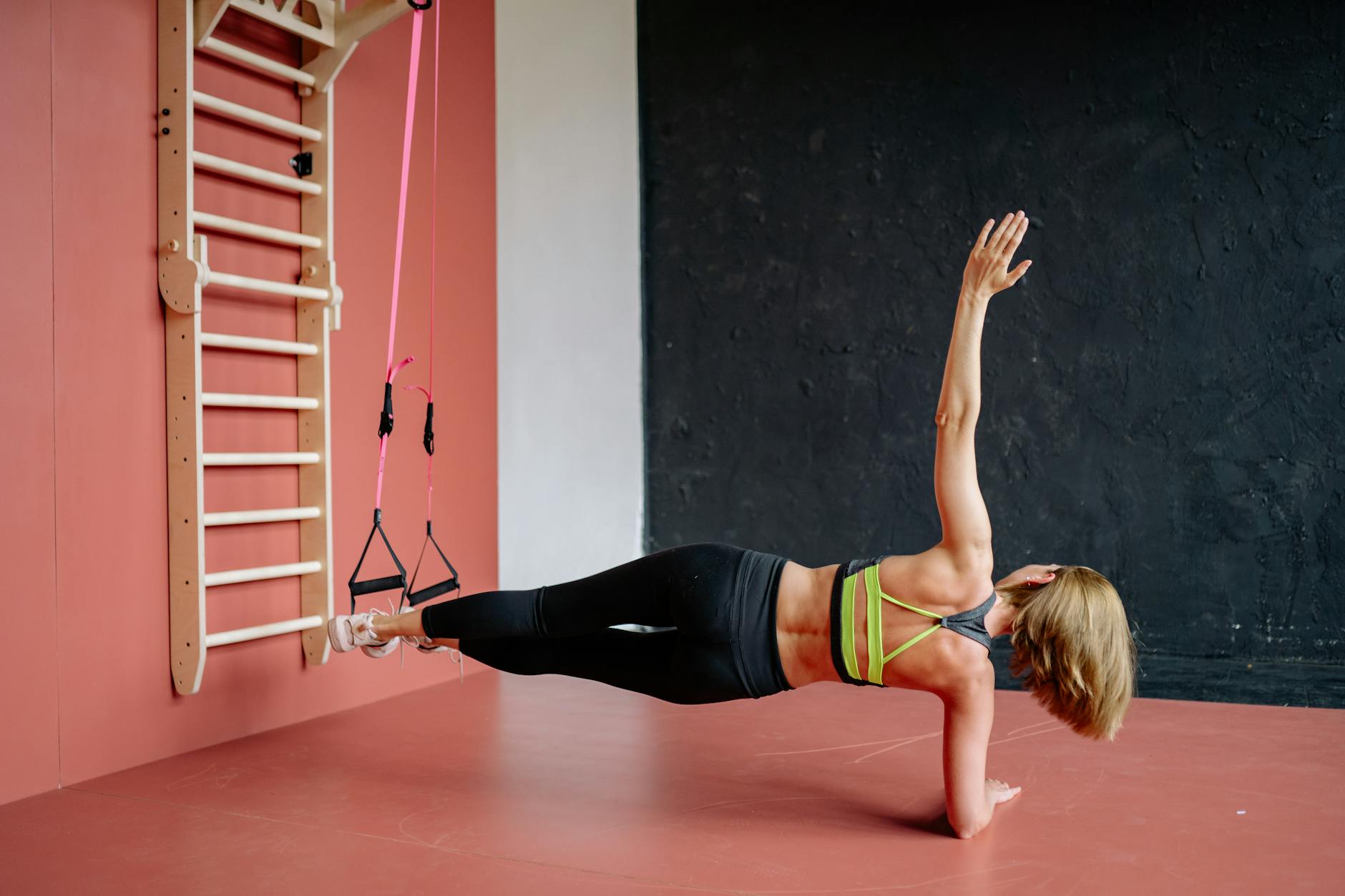
The deadlift covers the posterior chain – the hamstrings, glutes, and muscles running up the back – that the squat reaches less directly. It also trains the grip and develops the kind of pulling-from-the-floor strength that directly maps to real-world lifting tasks. Push-ups, meanwhile, are the upper-body counterpart: pressing the chest, shoulders, and triceps while simultaneously demanding core rigidity to keep the body in a straight line throughout the movement. A poorly performed push-up – hips sagging, lower back collapsing – reveals a core that isn’t contributing, which makes the exercise an honest diagnostic for full-body coordination as much as a chest exercise.
Rows complete the upper-body picture by training the pulling muscles of the back and the biceps, counterbalancing the pressing work done by push-ups and maintaining the postural balance that tends to deteriorate when pressing volume consistently outweighs pulling volume. Rounded shoulders and a forward head position are common in people whose training emphasizes pushing over pulling – rowing movements directly counteract that pattern. The fifth movement, a plank variation or core-specific exercise, addresses the stabilizing work that underpins every other exercise on the list. A strong core doesn’t just protect the lower back; it transmits force between the upper and lower body efficiently, which improves performance in every other movement.
What makes these five exercises worth returning to repeatedly isn’t novelty. It’s density – the amount of muscular and neurological work they generate relative to the time they require. A 45-minute session built around these movements, performed with appropriate load and rest intervals, delivers a training stimulus that most machine-based isolation routines simply can’t match for efficiency. That efficiency matters for the large portion of people who don’t have two hours a day to spend in a gym but still want a training approach that builds lasting physical capacity.
The mental engagement factor also deserves more attention than it typically receives. Compound movements require concentration – tracking the position of multiple joints, maintaining breathing patterns, adjusting load based on how the body responds on a given day. That active problem-solving during a session is part of what makes full-body training feel different from moving through a circuit of machines. Isolation exercises on fixed equipment reduce the movement to a single variable. Compound movements keep the brain working alongside the body, which may partly explain why people who train this way report higher session satisfaction over time.
What This Means for How You Structure Your Week
Full-body training doesn’t require daily sessions to be effective – in fact, recovery is built into the model. Two to three full-body sessions per week, with rest days between them, allows each session to be performed at sufficient intensity while giving the body time to adapt. That structure fits more naturally into irregular schedules than split routines, which depend on hitting specific muscle groups on specific days to avoid overlap. Miss leg day on a split program and the imbalance compounds; miss a full-body session and the next one simply picks up where the last one left off.
The shift toward this approach is visible in how time-pressed people are rethinking daily habits more broadly – fitting consequential physical practice into constrained windows rather than waiting for ideal conditions. A squat is still a squat at 6 a.m. before a work call. The question isn’t whether the conditions are perfect for training. It’s whether the five movements get done at all – and whether the body, over years rather than weeks, stays capable enough to keep doing them.